
Bouncie
Tail Light, LLCAuto & Vehicles
4.2674.00 Reviews
- Version
- 4.25.13
- Installs
- 100.00K
- Age Rating
- Everyone
Screenshots
Our Review of Bouncie
 Analysis by Appyee
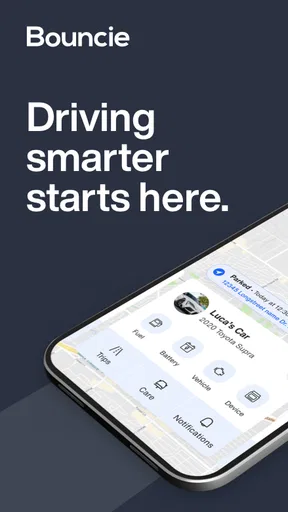
Bouncie is the kind of driving app that makes a strong first impression because it turns ordinary car use into something easier to observe. I found the appeal less about staring at another dashboard and more about having a clearer picture of what is happening between trips. It sits in the Auto & Vehicles category, is free to download, and is made by Tail Light, LLC. The store summary describes it as a starting point for connected driving, but my experience is that its real value appears when it becomes part of a routine rather than a novelty.
That distinction matters. A connected-car tool can feel fascinating during the first few days, when every trip seems worth checking. After that, the question becomes much more practical: does it help me make better decisions, communicate more calmly with family members, or keep a useful record of vehicle activity without demanding constant attention? Bouncie has a reasonable case for staying installed, especially for households sharing a car or monitoring regular drivers, but it is not equally useful for everyone.
What Bouncie feels like during the first week
The first week is mainly about learning how the app fits around driving instead of replacing the driving experience. I would not treat it as an entertainment app or something to open repeatedly while on the road. Its usefulness comes from checking information before or after a trip, when I can think about what happened and decide whether anything needs attention.
That makes the app particularly appealing to people who want more visibility without building a complicated system of their own. A parent may want a calmer way to understand routine vehicle use. A household with more than one driver may want a shared point of reference. Someone who lends a car occasionally may appreciate having a clearer record of activity rather than relying entirely on memory or a hurried phone call.
The free price lowers the barrier to trying it, although free does not automatically mean effortless. Connected driving usually depends on more than the app itself, so I would approach Bouncie as part of a vehicle-monitoring setup rather than as a standalone replacement for every car feature. That is an important expectation to set before installing it: the app can organize connected information, but it cannot turn an older vehicle into a complete modern infotainment system.
During initial use, I recommend deciding what question you want Bouncie to answer. “Where is the car?” is different from “How is the car being used?” and both are different from “Can this help me maintain the vehicle?” If I open the app without a purpose, the experience can become a stream of observations. If I use it to confirm a trip, review a concern, or support a household agreement, it feels much more grounded.
One useful first-week habit is to check the app at a fixed time rather than after every journey. For example, I might review activity once after the day’s driving is finished. This reduces the temptation to turn connected driving into constant supervision and makes unusual events easier to notice because I am comparing them with a normal pattern.
The app has earned a 4.2 average from around 1.8 thousand ratings, with more than 600 written reviews, and that gives a prospective user a useful sense of its position: it is established enough to have a substantial audience, but it is not something I would choose blindly for every driving situation. I would still judge it by the needs of the vehicle and the people using it.
Who gets the quickest benefit
Bouncie makes the most immediate sense for a family that shares responsibility for a vehicle. Imagine a weekday in which one person takes the car to work, another uses it for school pickup, and a third needs it in the evening. Instead of asking several people to reconstruct the day, I can use the app as a common reference point. That does not remove the need for communication, but it can reduce small misunderstandings about when the vehicle was used or whether a trip has already happened.
It can also suit a cautious driver who wants a stronger sense of context around regular journeys. A short trip to a familiar place should look familiar over time. If the pattern changes, that may prompt a conversation or a closer look. The important benefit is not treating every difference as a problem; it is having enough continuity to distinguish an unusual event from ordinary variation.
On the other hand, I would skip it if I only want turn-by-turn navigation, music control, or a simple vehicle manual. A navigation app is better for directions, and a manufacturer’s own app may be better when the main goal is controlling supported car functions. Bouncie is more focused on connected awareness than on replacing those tools.
Why the value either grows or fades after the first month
After the initial curiosity wears off, Bouncie has to justify its place through repeated, low-effort usefulness. I think it does that best when several people rely on the same vehicle or when the owner wants a consistent overview instead of occasional guesswork. The strongest long-term case is not checking every detail; it is using the app to support a few repeatable decisions.
One example is household coordination. If everyone knows that the app is there to clarify vehicle use, it can prevent unnecessary messages and reduce arguments based on incomplete information. Another is trip context. A person responsible for a car may notice that a vehicle is being used at unexpected times or that a supposedly routine journey has changed. Those observations may not solve a problem by themselves, but they provide a better starting point for asking the right question.
A less obvious use is creating a personal baseline. I would spend the first few weeks learning what normal activity looks like for that specific vehicle and household. Once that baseline is familiar, I would stop treating every notification or irregularity as equally important. This is a better long-term strategy than reacting to everything, because connected data becomes tiring when it has no priority system.
Another practical workflow is to pair app checks with existing routines. I might look at Bouncie when planning the next day’s errands, when handing a car to another family member, or when reviewing the week before a service appointment. That turns the app into a decision tool. It also avoids the common failure mode in which I install a monitoring app, inspect it enthusiastically for a few days, and then forget why it is on my phone.
For people managing more than one regular driver, the long-term benefit depends heavily on trust and clear expectations. I would discuss what information is being used for and when it is appropriate to check it. Without that conversation, the same feature that feels reassuring to one person can feel intrusive to another. Bouncie cannot solve that relationship issue; it can only make vehicle activity easier to observe.
The app is also more valuable when I treat it as supporting evidence rather than an absolute verdict. A recorded trip or unusual pattern can tell me that something deserves attention, but it does not automatically explain why it happened. Weather, a detour, an emergency, or a simple mistake may account for a difference. That nuance prevents the app from becoming a source of unnecessary suspicion.
Where it fits beside familiar alternatives
Compared with a basic odometer, Bouncie can offer a more useful view of activity because an odometer only shows accumulated distance and says little about who used the car or when. Compared with a handwritten mileage log, it can reduce the work of remembering every journey. The trade-off is that a manual log gives me complete control over what I record and why, while an app asks me to adopt its way of organizing connected driving.
Compared with a vehicle manufacturer’s companion app, Bouncie may be the more natural choice for someone who wants a dedicated connected-driving experience rather than a broad collection of ownership tools. A manufacturer app can be preferable when it is deeply integrated with a particular car, especially for functions that depend on the vehicle brand. Bouncie is more attractive when the priority is a consistent monitoring habit across a household’s everyday use.
Compared with simply calling or texting another driver, the app can reduce uncertainty, but it should not replace a direct conversation. A message still explains intent, context, and emergencies better than a record of activity. I see Bouncie as a way to make those conversations more informed, not as permission to avoid them.
This is also why I would not recommend it to someone who dislikes connected services on principle. Even a well-designed monitoring tool can feel like an extra layer between driver and vehicle. If privacy concerns, shared-device boundaries, or a preference for entirely manual records are central to your decision, a simple logbook or the car’s existing instruments may be a better fit.
The maintenance burden is small only when the routine is clear
The app itself may be easy to open, but maintaining its usefulness requires a little discipline. I need to keep the vehicle setup consistent, make sure the right people understand how the system is being used, and avoid letting old assumptions guide current decisions. The technical side is only part of the maintenance burden; the social side can be just as important.
I would begin by deciding who is responsible for checking the app and what counts as an action-worthy event. If everyone is responsible, nobody may actually review it. If one person is responsible for everything, that person may eventually feel burdened. A simple household agreement works better: use the app for coordination and unusual activity, but do not turn it into a minute-by-minute demand for explanations.
It is also wise to review whether the app is still solving the original problem. If I installed Bouncie after a temporary concern and that concern has passed, I should ask whether the ongoing attention is still worthwhile. Conversely, if the app has become part of a useful weekly routine, I should keep that routine simple enough to survive busy periods.
Version 4.25.13 is the current version, and the app supports Android 7.0 or later. That makes it accessible to many older Android phones, which is helpful in a household where not everyone upgrades devices at the same time. Still, compatibility alone does not guarantee a smooth experience on every phone. I would keep the app updated when practical and pay attention to whether it remains reliable on the device used for regular checks.
A useful maintenance tip is to avoid making Bouncie the only place where important information lives. If a vehicle needs servicing, insurance documentation, or an urgent repair, I would keep those details in the appropriate records as well. The app can support awareness, but it should not become a single point of failure for every vehicle-related task.
Another overlooked burden is interpretation. The more often I check connected information, the more likely I am to notice harmless variations. I find that a scheduled review is healthier than constant checking. It preserves the app’s value while protecting attention, trust, and time.
What can create fatigue over time
The biggest source of fatigue is repetition without a decision attached. If every trip is reviewed but no action follows, Bouncie can start to feel like another notification-heavy utility. The first-week excitement comes from discovery; the long-term test is whether the information remains relevant after I already understand the usual pattern.
Shared-car dynamics can create a second kind of fatigue. One person may see the app as a safety net, while another sees it as surveillance. Neither reaction is automatically correct. The technology may be useful, but the household still needs boundaries about when checking is reasonable and how unusual activity will be discussed.
There is also a risk of false confidence. Seeing connected information can make me feel that I understand the whole situation when I actually understand only the activity visible through the app. It does not replace responsible driving, direct communication, mechanical inspection, or professional service. I would be especially cautious about using it as proof that a vehicle is healthy; vehicle condition requires more than an app-based overview.
For an individual driver with one car and a predictable routine, the value may fade faster. If I already know where the car is, rarely lend it out, and have no need to coordinate trips, I may open Bouncie only out of habit. In that case, a simpler alternative may be more satisfying. The app is not automatically better merely because it provides more connected information.
Frequent travelers may also find the experience less compelling if their main need is navigation, parking, fuel planning, or roadside assistance. Those tasks are better handled by specialized apps or services designed around them. Bouncie’s strength is its focus on connected vehicle awareness, so using it as a universal driving companion would create expectations it may not be meant to meet.
My best strategy for avoiding fatigue is to define a narrow purpose, review only what supports it, and reassess after several weeks. If the app helps coordinate a family vehicle, keep that as the center. If it helps establish a record of use, focus on that. The less I ask it to do, the easier it is to notice when it is genuinely helping.
My long-term verdict on Bouncie
Bouncie earns lasting space on my phone when it is connected to a real recurring need: shared-car coordination, a desire for better visibility into vehicle use, or a household routine that benefits from a common source of information. Its free entry point and Everyone content rating make it approachable, while its established presence—more than 100 thousand installs—suggests that it has found a meaningful audience.
I would recommend trying it to families and vehicle owners who want less guesswork and are willing to agree on sensible boundaries. I would also recommend giving it enough time to pass the novelty stage. The first few checks are not the real test. The real test is whether I still use it after the familiar trips stop being interesting and whether it helps me make a decision with less effort.
I would skip it if I only need directions, entertainment, or manufacturer-specific controls, or if I strongly prefer a completely manual approach to vehicle records. In those situations, a navigation tool, a carmaker’s own application, or a simple written log may be more direct. Bouncie becomes worthwhile when connected awareness itself is the goal.
My final impression is balanced: the app is most valuable as a quiet household utility, not as something to monitor constantly. Used with a clear purpose, it can reduce uncertainty and support better routines. Used without boundaries, it can create more checking, more interpretation, and more tension than the original problem deserved. For me, that makes Bouncie a practical recommendation for the right driver rather than an essential installation for everyone.
Tail Light, LLC has positioned it as a focused Auto & Vehicles app rather than an all-purpose driving platform, and that focus is part of its appeal. I would install it when I can name the recurring problem it should solve, set a reasonable review habit, and involve the people who share the vehicle in that decision. If those conditions are present, it has a fair chance of remaining useful long after the first week.
Verdict
Strengths of Bouncie
- Real-time location updates help you monitor a vehicle’s current position.
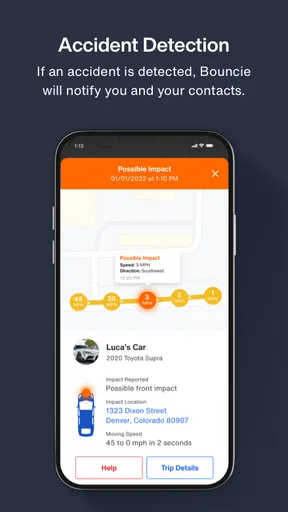
- Crash detection can alert selected contacts after a serious impact.
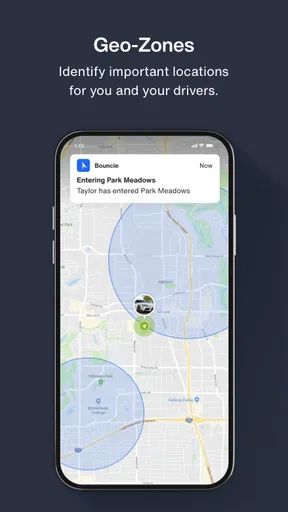
- Geofencing notifies you when a vehicle enters or leaves chosen areas.
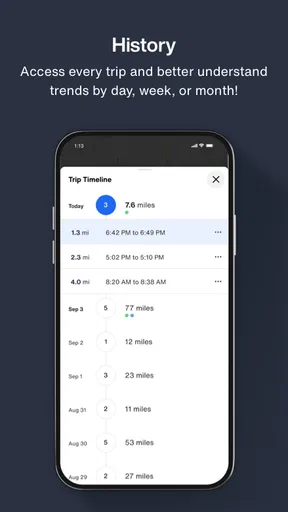
- Trip history makes it easy to review routes, stops, and driving activity.
- Low-profile hardware is simple to install and stays out of the way.
Limitations of Bouncie
- Requires a separate Bouncie device and an active subscription.
- Tracking quality depends on cellular coverage and GPS availability.
- Frequent alerts may become overwhelming for families with multiple vehicles.
- Some features vary depending on the vehicle and installation setup.
- Battery and power use may be a concern for certain older vehicles.
Similar Picks in This Category
View All
Android Auto
Google LLC4.1

maxim — order a taxi & food
PT. SITO4.7

Штрафы ГИБДД: проверка с фото
Pays LLC – Штрафы ГИБДД4.7

Номерограм – проверка авто
Авто Ассист4.8

Дром Авто
Дром4.9

Frequently Asked Questions
What is Bouncie, and how does it work?
Bouncie is a connected-car tracking service designed to help you monitor a vehicle’s location, driving activity, and overall usage. It typically works with a small GPS device that connects to the car and sends information to the Bouncie mobile app. After installation, users can view trips, receive alerts, and check driving details from an Android or iOS phone.
What features does the Bouncie app offer?
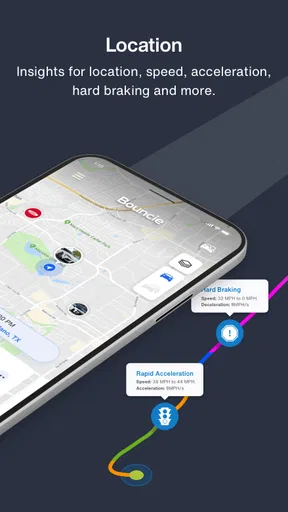
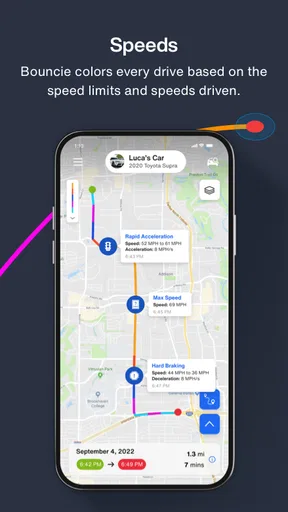
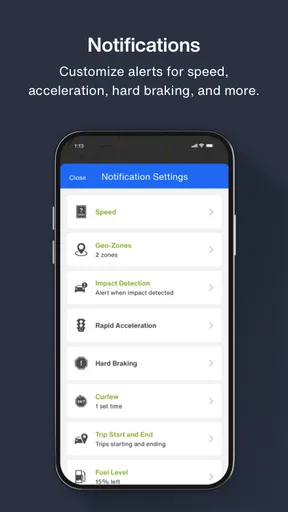
The Bouncie app provides several practical features for vehicle monitoring. Depending on the subscription and device setup, you can view real-time or recent vehicle locations, review trip histories, receive alerts for speeding or unusual activity, and monitor events such as hard braking, rapid acceleration, or possible collisions. It can also help families keep track of vehicles and driving habits.
Does Bouncie require a subscription or additional hardware?
Yes, Bouncie generally requires both compatible hardware and an active service subscription. The tracking device must be installed in the vehicle, while the subscription supports cellular connectivity and access to the app’s monitoring features. Before downloading or purchasing, check the current pricing, activation costs, supported vehicle requirements, and whether the device is included or billed separately.
Is Bouncie suitable for parents and family vehicle monitoring?
Bouncie can be useful for parents or families who want visibility into how a vehicle is being used. Trip notifications, location information, and driving-event alerts may help you understand when a car is being driven and identify potentially unsafe habits. However, it should be used transparently, with the driver’s knowledge and in accordance with local privacy laws and household agreements.
Will Bouncie work with every vehicle and smartphone?
Bouncie is not guaranteed to work with every vehicle or phone. Compatibility can depend on the vehicle’s diagnostic port, model year, cellular coverage, and the operating system version supported by the app. Before ordering the device, review Bouncie’s official compatibility information and confirm that your Android or iPhone meets the current technical requirements for installation and reliable tracking.
